
Tinicsh Hollins
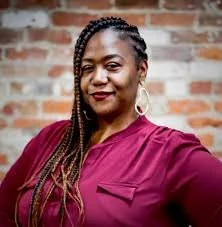
Tinisch Hollins is a San Francisco-born community organizer, policy advocate, and civic leader whose work spans public safety, survivor advocacy, economic justice, reparations, and building Black community power.
Raised in San Francisco’s Bayview, Hollins has spent much of her career working at the intersection of lived experience and public policy. Her work has included leadership roles with the San Francisco Mayor’s Office and Human Services Agency, as well as statewide advocacy around criminal justice and public safety. A consistent principle runs through that work: people most affected by public policy should have a meaningful role in designing it.
Hollins is Executive Director of Californians for Safety and Justice, where her work has focused on centering crime survivors in conversations about safety, healing, violence prevention, and public investment. She has helped build statewide organizing efforts that bring survivors directly into policy-making rather than treating them simply as recipients of services.
She is also a co-founder of SF Black Wall Street, created to strengthen Black economic mobility, entrepreneurship, culture, and community in a city where the Black population has declined dramatically over generations. Under Hollins’ leadership, the organization built an ecosystem supporting more than 90 Black entrepreneurs and distributed nearly $1 million in grants over two years, alongside technical assistance, cultural programming, events, and access to markets and partnerships.
In 2026, that work expanded beyond San Francisco with the launch of Bay Area Black Wall Street, reflecting both the displacement of Black San Franciscans and the increasingly regional geography of the community. Hollins herself grew up in the Bayview but now lives outside San Francisco because of the cost of housing—a personal experience that also informs her work around displacement, wealth, and belonging.
Hollins has also served on San Francisco’s African American Reparations Advisory Committee, bringing both her organizing experience and her own experience of displacement to the city’s examination of the continuing effects of historic discrimination against Black San Franciscans.
Across all of this work is a larger question about who gets to remain in a city, build wealth there, shape its institutions, and see their culture reflected in its future.
As Hollins has put it, “Black San Francisco is not a geographical space, and Black San Francisco is not monolithic.”
That makes her work particularly relevant to the ongoing Sidewalk Ballet conversation: cities aren't only collections of buildings and public spaces. They're communities of people—and creating places where people belong also means creating the economic, cultural, and civic infrastructure that allows them to stay.