
Coexistence in Public Space
Engagement tools for creating shared spaces in places with homelessness
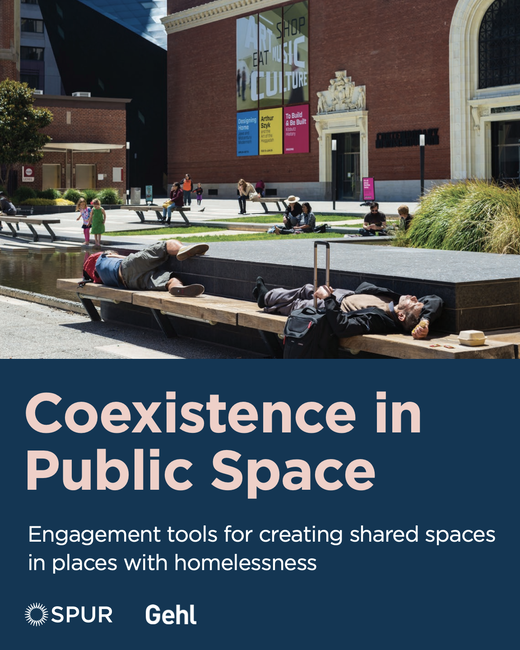
Coexistence in Public Space is a 2021 report and engagement toolkit developed by SPUR and Gehl that asks a deceptively difficult question: How can public spaces provide joy, belonging, and safety for everyone—including people experiencing homelessness?
The work grew out of SPUR’s long-term research on Guadalupe River Park in San José, where homelessness had become central to conversations about the park’s use, safety, and future. Like many public spaces, the park had become a place where people without housing lived because they had few alternatives. At the same time, some housed residents described the presence of unhoused people as making the park feel unwelcoming or unsafe.
Rather than beginning from the premise that a successful park required removing unhoused people, SPUR and Gehl proposed a fundamentally different goal:
Shift from “the park will only be great if there are no homeless people in it” to “the park will only be great if we design for coexistence.”
That shift changes the planning question. Instead of asking how to eliminate a particular group of people from public space, the project asks how design, programming, management, and community engagement might accommodate people with very different needs and circumstances sharing the same place.
The resulting Coexistence Toolkit provides exercises that public agencies, nonprofit organizations, park stewards, and communities can use to have more productive conversations about homelessness, safety, access, and belonging. Although developed through work at Guadalupe River Park, the tools were intentionally designed to be applicable to other parks and public spaces.
The larger idea is important: coexistence doesn't mean pretending that conflicts in public space don't exist. It means recognizing those conflicts without making exclusion the default solution. Public space is shared space, and creating genuinely public places requires figuring out how people with different needs, vulnerabilities, expectations, and definitions of safety can inhabit them together.