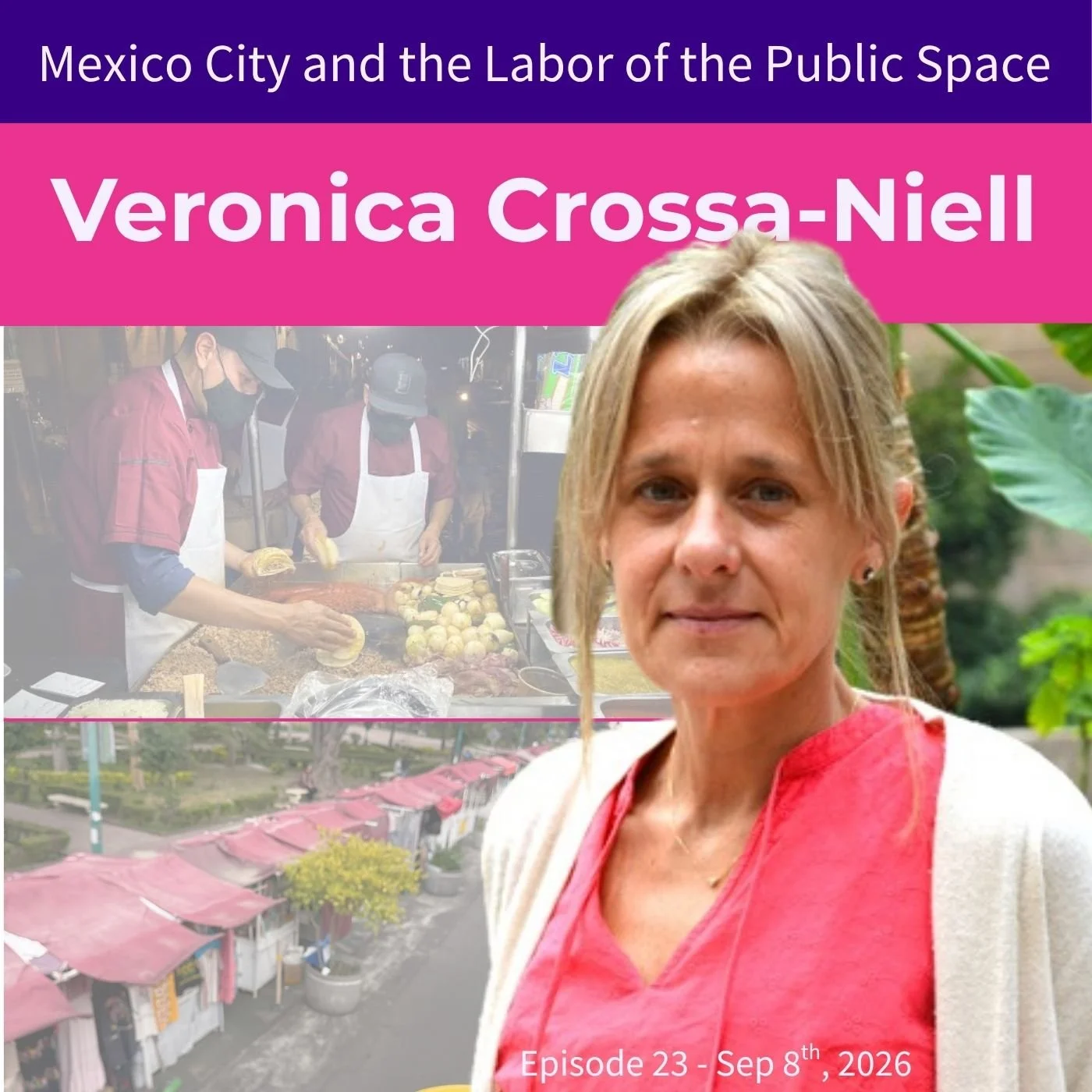
Veronica Crossa

Verónica Crossa Niell is an urban scholar whose work explores public space, street vending, informality, inequality, and the politics of who gets to occupy the city. She is a professor-researcher at El Colegio de México’s Center for Demographic, Urban and Environmental Studies, where her research focuses particularly on public space, street commerce, inequality, and public markets.
Much of Crossa’s work has centered on Mexico City and the tension between the idealized public space imagined by planners and governments and the complicated, negotiated, sometimes messy public space of everyday life.
Her research examines street vendors not simply as an obstacle to circulation or an urban-management problem, but as people whose livelihoods, relationships, identities, and everyday lives are deeply embedded in streets and plazas. That perspective complicates familiar efforts to “rescue,” beautify, regulate, or revitalize public spaces—particularly when making a place more attractive for investment or consumption requires removing some of the people already using it.
Her 2018 book, Luchando por un espacio en la Ciudad de México: Comerciantes ambulantes y el espacio público urbano (Fighting for Space in Mexico City: Street Vendors and Urban Public Space), examines these conflicts through Mexico City’s Historic Center and Coyoacán. Crossa looks at government efforts to reclaim and beautify public spaces alongside the ways street vendors negotiate, adapt to, evade, and resist displacement.
That resistance can take unexpected forms. Her work in Coyoacán examines vendors and artisans responding to displacement not only through conventional political protest, but through music, dance, workshops, photographs, performance, and other playful interventions. Crossa uses these practices to explore the emotional and symbolic relationships people develop with places—and the different ways people assert a right to remain part of them.
Underlying her work is a deceptively important question for anyone engaged in placemaking: when we say a public space needs to be improved, rescued, cleaned up, or activated, whose definition of a good public space are we using?
Crossa’s research reminds us that public space isn't simply a physical setting waiting to be professionally designed. It is produced every day through use, conflict, negotiation, livelihood, attachment, transgression, and resistance.
And sometimes the people who make a place feel inconvenient, disorderly, or difficult to manage are also among the people most actively making it public.
Featured in Episode 23